"Straight down the line, all the way."
This ironic train reference sets the tone for this incredibly innovative movie of the film noir Genre.
Double Indemnity is the riveting tale of an insurance salesman, named Walter Neff, who ends up in a corrupt murder for accident insurance pay-offs and the girl of dreams, neither of which he got.
I believe that what makes this film so quintissentially noir is the character of Phillys Diedrichson. Throughout the entire movie, Phillys - as played by Barbara Stanwyck - emulates a feeling of double trust. To trust or not to trust? Her words sound meaningful and sincere, they speak of pain and love for Walter; while her eyes emit a feeling of deceit, of an inability to trust, and more than anything - an innate evilness. The Noir - darkness - of this film - more subtly than the dark rooms and dark plot - lies in the shadows of Stanwyck's character.
I found that the focus of this movie was in the emotions more than the plot. Stanwyck's femme fatale persona, Neff's naivity, or Keyes disappointment. Each of the actor emits a feeling of deceit and suspicion, and is expertly captured by Billy Wilder.
The bantinage was an important factor of the movie that was comically overlooked. It is because of Neff and Diedrichson's quick speaking that they are able to keep each other at an arms length - it unfortunately ends up being Neff's undoing...he should've gotten closer.
Monday, October 29, 2007

Friday, October 26, 2007
Darjeeling doody
I recently saw Wes Anderson's latest film, Darjeeling Limited, with two friends, who shan't be named. Anywho, as i do for most Wes movies, i loathed this piece of trash. Yet with the new cinematic eye that i am developing in Art of Film, i have been able to put into words why i despise anything that comes out of Mr. Anderson's putrid cameras.
It is his direction
Mr. Anderson has a tendency to make arbitrary mistakes with camera movements on purpose. This is a technique that i believe he thinks will allow for a more personal,intimate feeling, between the audience and the characters. I think that this is an unjustified, and therefore unintelligent, decision. The occupation of a director is story teller, they can ornament and edit to add aesthetic beauty or even opinionated statements; but, it is never the position of the director to act as a character. The director is supposed to be the fourth wall, a communicator, a medium for art. Not an extra opinion.
Wes Anderson's overly personal camera techniques ruin all of his films for me.
I hate your work Wes Anderson
I hate it
It is his direction
Mr. Anderson has a tendency to make arbitrary mistakes with camera movements on purpose. This is a technique that i believe he thinks will allow for a more personal,intimate feeling, between the audience and the characters. I think that this is an unjustified, and therefore unintelligent, decision. The occupation of a director is story teller, they can ornament and edit to add aesthetic beauty or even opinionated statements; but, it is never the position of the director to act as a character. The director is supposed to be the fourth wall, a communicator, a medium for art. Not an extra opinion.
Wes Anderson's overly personal camera techniques ruin all of his films for me.
I hate your work Wes Anderson
I hate it
Monday, October 8, 2007

Set in late 80's early 90's brooklyn, "Do the Right Thing," gives an inside look at the boiling racial tensions on a blisteringly hot day in the borough. The reason why i truly loved this movie, is because it valued the thoughts of the viewer, constantly asking the audience quesitons. "Who was in the wrong in the end?" "Why can't we just get along?" "Is violence the answer to any problem?" Spike Lee is a great director in his ability to present a risque issue in an almost completely objective fashion. One could interepret his position in a million ways- he supports mookie in the end, he supports Sal, he supports violence, he hates violence.
From a cinematic angle, this movie was really a great success. Lee's use of canted angles, close-ups, and low and high angles fully show the passions that these people are experiencing living in these extreme conditions. What really enticed me was the scene where various characters are alone on the screen yelling racial slurs and the camera is zooming in on them. What surprised me about this point in the movie is that all of the rants were asides. These werent said directly to people, they were said to the camera - purposefully breaking the fourth wall. What made this an exelent cinematic choice is the bluntness: rather than have the viewer interepret characters' facial expressions, and subtelties, Spike Lee puts it right on the table how certain people feel about others.
Dramatically i was captured by Sal's character. A sad man who has undying faith in the people who he cooks for, ends up being the victim of a riot. It is like biting the hand that feeds you.....literally. The actor - Dan Aiello, who recieved an Oscar nomination for this role - really captured the sad rejection that Sal is experiencing. His performance moved me.
Another aspect that i thought was vital to this movie was Spike Lee's choices in music. Sticking with the theme of showing the vibrant culture of Brooklyn, Lee puts jazz, gospel, and soul music into this movie. What is interesting is that sometimes he puts it at moments where it makes the least sense. For instance: a sad gospel during a happy scene, an upbeat jazz piece during a time of morbidity. It was an interesting contrast that i dont completely understand, but i appreciate.
Monday, October 1, 2007
MMMMMMMMMMMM

This was certainly an enticing movie. However, althouth this does fall under the category of German expressionism which houses more extreme expansions of the mind in the cinematic sense, i found this to an exemplary movie based on its dramatic elements - mainly Peter Lorre's contribution.
Lorre did an outstanding presentation of the psychotic child murderer Hans Beckert. It is my sense that most actors during that era were of the method acting school. I find it hard to believe that Lorre acted like a child murderer for the months leading up to this movies produciton......which makes his performance all the more remarkable. The quick but detailed mental breakdown of Beckert is not best expressed through Lang's mastery of film - which should be mentioned, are present throught the movie and are not to be left out - but through Lorre's mastery of human emotion and psychology. It takes a true virtuoso to make an audience feel for a murderer - a child murderer at that, yet that is what Lorre is, a master of his craft.
I think the name of Lang's game is simplicity. This being his first sound-movie, i find it amzaing how seamlessly Lang integrated the sounds - diagetic and non - with the movie. It added intensity, fear, and captured the audience fully. Yet Lang did nothing huge, nothing ostentateous, nothing that would bring the word "expressionism," to most peoples' minds. Lang finds beauty and emotion through his actors, and through subtle backround indications of symbolism.
A great movie and an important step in the future of crime-dramas. I believed it to be a masterpiece. I give it four out of four replays.
Monday, September 24, 2007
Once
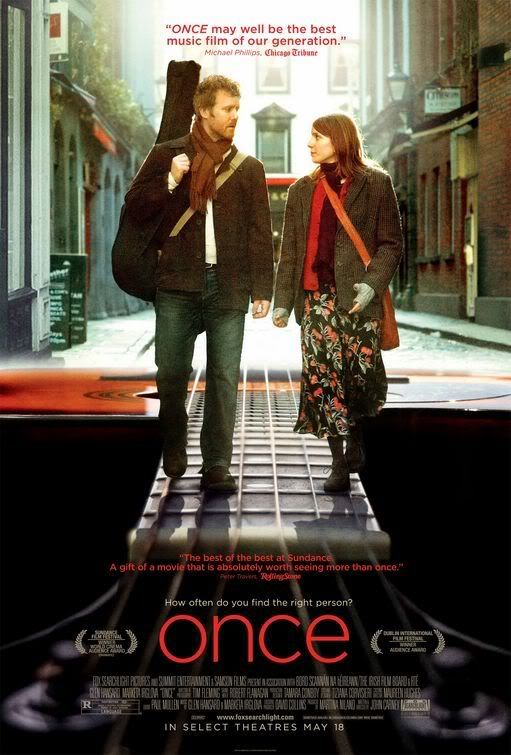
I saw this movie last week entitled: Once. Which, despite being horibly annoying when asking people if "they had seen the movie Once" they would almost always reply "Yeah, it was so good i saw it twice. " Not funny. Unfortunately not that many people saw this documentary exploring the sidewalk singer/poet. This heart-warming tale tells the story of a man - Glen Hansard - and how he is trying to break into the music world. Starting from a sidewalk singer, and ending with selling records in London. However, he does not do this alone, he finds this muse in the form of a Czech woman named Marketa Irglova. She helps him take his mind of his ex-girlfriend, and then writes songs for her. I probably did an incredibly subpar job of doing the plot description. I hope i do a better review.
All in all, this was a pretty great movie, i really loved the incorporation of music to really express the feelings of the main character - Glen, at first it is disturbing, brash, unrefined. yet by the end it is beautifully constructed and appreciated by all around him. The seamless incorporation of the music into the movie really made the movie personal, which made it all the more moving.
The style it was shot in could best be described as mainly medium shots. It is almost entirely done as natural shots, very little cinematographic aspects incorporated. Which, again, made the movie the more personal. It allowed the watcher to be viewing it like it is just a passer-by - it is best described as being in the Third person narrative. Excelently directed in its lack of direction. if that makes any sense.
Either Way! it was an incredibly touching movie and i reccomend it to all. Especially if your looking for a romantic date movie. I really liked this song from it entitled "Falling slowly," check it out!
Sunday, September 23, 2007
Excited for the new week!
its a new week of art of film and that means only one thing- a new movie! I'm psyched to see what Daz has in store. A comedy? a Drama? A Dramedy? who knows? only time will tell!
Wednesday, September 19, 2007
Witness
We are two days into Witness, and i have to say it's pretty OK so far. I don't really dig the story that much, but directorilly its pretty good. That one scene where the kid was pointing at the picture of McFee - that was really cool. It was like the whole room stood still except for Harisson ford and the kid.
So far I'm really liking this class, it's nice to know that at least one period in a day, you get to watch a movie
So far I'm really liking this class, it's nice to know that at least one period in a day, you get to watch a movie
Subscribe to:
Posts (Atom)