Thrilling to the very last second, Primal Fear is a carefully constructed courtroom drama that tends to exceed the confines of its otherwise stock genre. In most Law dramas there is a one-sided victory it seems until *gasp* a surprise witness?!?!?! OH MY GOD, NO WAY! Primal Fear offers a refreshing respite from this stereotype by having perpetual suspense highlighted by the phenomenal acting efforts of Edward Norton and Richard Gere.
Fear tells the story of Richard Gere as a high-powered attorney in Chicago Defending a murderer (when first describing this to my brother, he was certain the title of the movie was "Chicago" (not quite the same)). Gere's character, Martin Vale, has conflicted interests: he wants the notoriety and fame of being a defense attorney which is why he accepted the case of an archbishop being murdered by a choir boy named Aaron Stampler (Edward Norton), but by the end he becomes ambivalent about his feelings towards the fame of his position and even his feelings about the justice system in general.
As if the phenomenal acting and script weren't enough, Gregory Hoblit does an exquisite job of directing. Utilizing the juxtapositions of just and evil to show who are truly the righteous law abiding people in our society.
Ed Norton is really the standout of this film, as the psychologically distrubed Aaron Stampler, accused of murdering an archbishop he is trying to prove himself to his very own attorney. What makes his character so incredible, is the stutter. Each scene of this movie is excrutiatingly tense and suspenseful, but any scene with Norton makes every word suspensful - because you are never sure what may or may not come out of the quivering lips of the disturbed Aaron Stampler
For once, we come apon a drama that doesnt only make you want to know what happens next, but also makes you think.
Thank you Olivia Zhao for making this article happen.
Sunday, January 27, 2008

Cinema Paradiso
Cinema Paradiso tells the tale of a young boy, and his relation to movies and the man who showed them to him. The film, set between the 1940s and the 1980s in a rural italian town in Southern Italy, is heart-warming, funny, and romantic - all at the same time.
What is truly remarkable about Cinema Paradiso, is that it is so honest in its portrayal of a peoples love for movies. Directly following WWII, Italy has been ravaged by war and is left in a grim state, with little more than a scrap of hope for happiness it seems. Yet, amongst all the misery, we see a vibrant lifestyle fueled by the majesty of film, which offers an escape for the otherwise depressing lives of the people who live in the village. When the reel starts rolling, and the lights go down, you truly see the lives of these people change, literally become better. The Cinema Paradiso becomes such a great escape from life, that it becomes their lives - people are conceived there, babies are nursed there, people sleep there, people eat there, people even die there occasionally.
It may sound odd, but i think that if this movie were American, it wouldn't be half as touching. There is something about the sadness of post- WWII that excentuates the beauty of the escape that the Cinema Paradiso.
What makes this movie so heart-warming to those who aren't physically in the Cinema Paradiso, is the fact that the audience can relate to the love for film. Because the escape of the movies is timeless. Everyone loves movies, and i love this one
What is truly remarkable about Cinema Paradiso, is that it is so honest in its portrayal of a peoples love for movies. Directly following WWII, Italy has been ravaged by war and is left in a grim state, with little more than a scrap of hope for happiness it seems. Yet, amongst all the misery, we see a vibrant lifestyle fueled by the majesty of film, which offers an escape for the otherwise depressing lives of the people who live in the village. When the reel starts rolling, and the lights go down, you truly see the lives of these people change, literally become better. The Cinema Paradiso becomes such a great escape from life, that it becomes their lives - people are conceived there, babies are nursed there, people sleep there, people eat there, people even die there occasionally.
It may sound odd, but i think that if this movie were American, it wouldn't be half as touching. There is something about the sadness of post- WWII that excentuates the beauty of the escape that the Cinema Paradiso.
What makes this movie so heart-warming to those who aren't physically in the Cinema Paradiso, is the fact that the audience can relate to the love for film. Because the escape of the movies is timeless. Everyone loves movies, and i love this one
The Searchers
The Searchers falls into a genre of movie that is unique to American culture: the western. The style of barren deserts, unkempt cowboys, and epic “gunslinger” moments, has taken a great deal of influence from the history of America and its western fronts, however often they may change. For the most part, the arc of a Western movie rarely changes: stranger rolls into town, a rivalry brews, trouble over a girl starts, good guy beats bad guy, happy ending. It rarely changes. This is where The Searchers finds its most redeeming quality.
Directed John Ford, who is hardly new to the genre of Western at this point in his career, delves deep into a character’s psyche, exploring his motives, history, etc. For what I imagine is one of the first times in the western genre, there is a flawed hero who does not quite fall into the mold of “good guy.”
The Searchers tells the story of Ethan, played by none other that John Wayne himself, a loner who strolls into town only a day before his whole family is either killed or kidnapped by a group of hostile Indians. Ethan swears vengeance, as if it was necessary to even swear, and spends the rest of the movie searching for the remaining members of his family who might have been kidnapped. He is accompanied by a inexperienced Martin Pawley, played by Jeffery Hunter, who wants so badly to find the closest thing to a family he has ever known. Here is where the psychological stuff comes in. Martin is one quarter Indian; Ethan is incredibly vengeful and racists towards all Indians, no matter the background – tension is immediate. As the movie rolls on, we witness more and more of Ethan’s imperfection, his craziness, highlighted by an otherwise static personality. One scene that truly exemplifies just how crazy Ethan can get, is when we see Martin and Ethan come across a herd of buffalo and decide to kill one for sustenance; Ethan shoots one, and then another, and then another, under the explanation that there will be “fewer for the Comanche {indians}.”
So despite a brand of acting which could not be more fake and unbelievable, The Searchers has a redeeming facet in being a new step in the genre of westerns. By taking that extra moment to actually establish the mindset of its characters, The Searchers distinguishes itself from all others in its field.
Directed John Ford, who is hardly new to the genre of Western at this point in his career, delves deep into a character’s psyche, exploring his motives, history, etc. For what I imagine is one of the first times in the western genre, there is a flawed hero who does not quite fall into the mold of “good guy.”
The Searchers tells the story of Ethan, played by none other that John Wayne himself, a loner who strolls into town only a day before his whole family is either killed or kidnapped by a group of hostile Indians. Ethan swears vengeance, as if it was necessary to even swear, and spends the rest of the movie searching for the remaining members of his family who might have been kidnapped. He is accompanied by a inexperienced Martin Pawley, played by Jeffery Hunter, who wants so badly to find the closest thing to a family he has ever known. Here is where the psychological stuff comes in. Martin is one quarter Indian; Ethan is incredibly vengeful and racists towards all Indians, no matter the background – tension is immediate. As the movie rolls on, we witness more and more of Ethan’s imperfection, his craziness, highlighted by an otherwise static personality. One scene that truly exemplifies just how crazy Ethan can get, is when we see Martin and Ethan come across a herd of buffalo and decide to kill one for sustenance; Ethan shoots one, and then another, and then another, under the explanation that there will be “fewer for the Comanche {indians}.”
So despite a brand of acting which could not be more fake and unbelievable, The Searchers has a redeeming facet in being a new step in the genre of westerns. By taking that extra moment to actually establish the mindset of its characters, The Searchers distinguishes itself from all others in its field.
Thursday, January 17, 2008
A Christmas story
AAAAAWWWWWWWWWWWWW!!!!!
This movie just screams cutesy-cuddley and heart-warming, and i am not complaining. The type of movie you wouldn't mind curling up in front of a fire watching when the weather outside is frightful. A simple story, with incredibly truthful portrayal of the Americanized christmas: Crazy department stores, long lines to visit a grumpy santa, and of course: the fog on the display case of your favorite toy.
A Christmas Story tells the tale of Ralphie Parker and his never ending quest to get the perfect christmas gift: the Red Ryder (numerous adjectives) BB gun. He must convince Santa and his parents of his good behavior, attempting to do well in school, helping his father change a tire, anything - despite cautions that he would "poke his eye out" with the beloved BB gun.
What i love most about this movie is its genuine nature. It was truly what i imagine being the All-American Christmas (in an almost entirely white neighborhood barring a few gospel singers around a trash can fire). I have had the same desire for gifts - for Channukah mind you - and would do anything to get it. What is so interesting to me is that the materialistic desire does not stop with the kids, everyone is obsessed with material goods - including an outrageously hideous leg-lamp - which is in the nature of American capitalism: greediness is ageless.
I find it hard to "review" this movie, because while watching it i found it difficult to pick at the cinematic and directorial nuances. While watching this movie, one can't help but be engulfed by the honesty and heart-warming essence of this film.
So if this blog is lacking, it is only because i can't put into words the kind of feeling one recieves while watching this movie. It is a film for all ages, and most importantly: all religions. Feliz Navidad.
Totally Innapropriate, but hilarious:
This movie just screams cutesy-cuddley and heart-warming, and i am not complaining. The type of movie you wouldn't mind curling up in front of a fire watching when the weather outside is frightful. A simple story, with incredibly truthful portrayal of the Americanized christmas: Crazy department stores, long lines to visit a grumpy santa, and of course: the fog on the display case of your favorite toy.
A Christmas Story tells the tale of Ralphie Parker and his never ending quest to get the perfect christmas gift: the Red Ryder (numerous adjectives) BB gun. He must convince Santa and his parents of his good behavior, attempting to do well in school, helping his father change a tire, anything - despite cautions that he would "poke his eye out" with the beloved BB gun.
What i love most about this movie is its genuine nature. It was truly what i imagine being the All-American Christmas (in an almost entirely white neighborhood barring a few gospel singers around a trash can fire). I have had the same desire for gifts - for Channukah mind you - and would do anything to get it. What is so interesting to me is that the materialistic desire does not stop with the kids, everyone is obsessed with material goods - including an outrageously hideous leg-lamp - which is in the nature of American capitalism: greediness is ageless.
I find it hard to "review" this movie, because while watching it i found it difficult to pick at the cinematic and directorial nuances. While watching this movie, one can't help but be engulfed by the honesty and heart-warming essence of this film.
So if this blog is lacking, it is only because i can't put into words the kind of feeling one recieves while watching this movie. It is a film for all ages, and most importantly: all religions. Feliz Navidad.
Totally Innapropriate, but hilarious:
Wednesday, January 16, 2008
Run Away
I am always willing to appreciate avant-garde films, foreign films, even mediocre films. But i draw the line at bad films
Run Lola Run is certainly an interesting film that makes you think about the importance of time, that every second counts. So in that field I give it credit. I even enjoyed the music choices that perfectly mirrored the feeling and emotion of almost every scene.
I go to the movies to be entertained, for the most part. A film where a woman is running for 70 minutes is just boring from my point of view. Not to mention the fact that only the smallest things changed each time. It is not like in the movie Memento, which i believe is similar in style, in which a little bit more is revealed each time; in this movie it is the same plot for every single scene.
I also had absolutely no attachment to any of these characters. When Lola got shot in the first scene i remember thinking: "that doesn't even look real, her blood looks like paint." When i should be thinking "Oh my God, is she gonna be ok!?"
Then comes the inexplicable nature of this character: Lola. She seems like a super hero with these mutant powers: she can run for incredibly long distances without getting tired, and she can scream to affect probability. Now i am a huge comic book fan, i love X-men and all of that, but at least some of that is explained a little bit. This is just some girl who runs places and screams a lot. That is honestly my feeling about the character of Lola.
By the way, if this guy Manni is doing all these drug deals anyway and he is wiling to shoot up a grocery store, then maybe he deserves to die.
I may be too critical. If you like movies like this (for 70 minutes):
Then be my guest.
Run Lola Run is certainly an interesting film that makes you think about the importance of time, that every second counts. So in that field I give it credit. I even enjoyed the music choices that perfectly mirrored the feeling and emotion of almost every scene.
I go to the movies to be entertained, for the most part. A film where a woman is running for 70 minutes is just boring from my point of view. Not to mention the fact that only the smallest things changed each time. It is not like in the movie Memento, which i believe is similar in style, in which a little bit more is revealed each time; in this movie it is the same plot for every single scene.
I also had absolutely no attachment to any of these characters. When Lola got shot in the first scene i remember thinking: "that doesn't even look real, her blood looks like paint." When i should be thinking "Oh my God, is she gonna be ok!?"
Then comes the inexplicable nature of this character: Lola. She seems like a super hero with these mutant powers: she can run for incredibly long distances without getting tired, and she can scream to affect probability. Now i am a huge comic book fan, i love X-men and all of that, but at least some of that is explained a little bit. This is just some girl who runs places and screams a lot. That is honestly my feeling about the character of Lola.
By the way, if this guy Manni is doing all these drug deals anyway and he is wiling to shoot up a grocery store, then maybe he deserves to die.
I may be too critical. If you like movies like this (for 70 minutes):
Then be my guest.
Look Closer
I had always liked this movie for its captivating performances by the phenomenal cast of Kevin Spacey, Annette Benning, Chris Cooper, Thora Birch, Wes Bently, and Mena Suvari. Each one representing, what i feel, are opposite ends of personality spectrums: Carolyn Bernham, (Benning) is anal retentive; Frank Fitts (Cooper), is a military man; Angela Hayes (Suvai), is shallow; Jane Bernhan (Birch), is misguided; Ricky Fitts (Bently), is incredibly profound and smart; and then there is Lester Bernham (Spacey) who is going through what those around him would call a mid-life crisis, but what he would call a great awakening. The quality of these breath-taking performances will never fade, but as i begin to look at this film with a more inquisitive eye I find a great artist hidden behind the screen: the director, Sam Mendes.
The extraordinary fact that this was Mendes's directorial debut only adds to the amazement that one experiences while watching this masterpiece. Gently woven into the fabric of the film are symbols of each characters mental state: Carolyn has the precise nature of her dining room table, Jane is constantly upset with her body, and Ricky is surrounded by his attempts to capture natural beauty through a lens. The symbolic nature in this movie is so vivid, and yet so subtle at the same time.
Then there are the roses. Practically the calling card of this movie, roses and rose petals are a ubiquitous presence throughout the film. However, they are most important to Kevin Spacey's character of Lester Bernham. Half-way through his life, Lester never learned to stop and smell the roses - now he is engulfed by them. Every time he thinks about Angela roses appear. They are the symbol of the Beauty that was missing in his life.
What is beauty? That is the focal point of the story, one could argue. It is my belief that this movie tries to break any sort of confinement that beauty might have and say that beauty truly is in the eye of the beholder. For Ricky it was Jane, even though she would be by most standards plain, for Carolyn it was her furniture, even though Lester only viewed it as stuff, and for Lester it was Angela, even though some might see her as shallow and fake - he saw her beauty.
The lesson of this movie is indeed its trademark line which is: "Look Closer."
The extraordinary fact that this was Mendes's directorial debut only adds to the amazement that one experiences while watching this masterpiece. Gently woven into the fabric of the film are symbols of each characters mental state: Carolyn has the precise nature of her dining room table, Jane is constantly upset with her body, and Ricky is surrounded by his attempts to capture natural beauty through a lens. The symbolic nature in this movie is so vivid, and yet so subtle at the same time.
Then there are the roses. Practically the calling card of this movie, roses and rose petals are a ubiquitous presence throughout the film. However, they are most important to Kevin Spacey's character of Lester Bernham. Half-way through his life, Lester never learned to stop and smell the roses - now he is engulfed by them. Every time he thinks about Angela roses appear. They are the symbol of the Beauty that was missing in his life.
What is beauty? That is the focal point of the story, one could argue. It is my belief that this movie tries to break any sort of confinement that beauty might have and say that beauty truly is in the eye of the beholder. For Ricky it was Jane, even though she would be by most standards plain, for Carolyn it was her furniture, even though Lester only viewed it as stuff, and for Lester it was Angela, even though some might see her as shallow and fake - he saw her beauty.
The lesson of this movie is indeed its trademark line which is: "Look Closer."
Sunday, December 30, 2007
Pleasantly Surprised
Rushmore review
Jordan Rochelson
Let me preface by saying that Wes Anderson is not a director that all viewers will, “fall in love with.” Director Wes Anderson’s unique style of blunt realism is one that is lost on many people, and admired by others. The former group dismisses Mr. Anderson as pompous, while the latter heralds him as a genius and innovator. I find myself leaning towards the first group. In the films in which his style is shoved in the face of the viewer, such as Darjeeling Limited (2007), the viewer feels lost and a tad insulted – as if we must be stupid if we didn’t understand the humor. However, there are occasions in which Anderson manages to curb his directness slightly, and it is in these occasions that Mr. Anderson flirts with greatness. Rushmore is a prime example.
The charming film tells the tale of Max Fischer, played by Jason Schwartzman: a prep school student on academic probation who falls in love with a first grade teacher at the school – Rosemary Cross (Olivia Williams). Fischer finds himself completely enticed by Ms. Cross – as he adoringly refers to her – and he spends most of his time trying to impress her and make her fall in love with him. Despite Fischer’s intelligence, he fails to see the obvious complication: he is a fifteen-year-old boy, and she is a teacher of thirty years (roughly). Both Schwartzman and Williams offer charismatic performances, as conflicted people without complete comprehension of their situation. A hilarious Bill Murray flanks the two, as the depressed millionaire Herman Blume who ends up falling in love with both Cross and Fischer it seems: Cross, because of her intelligence and beauty, and Fischer because he sees in him what he wants his hooligan sons to be. It is a hilarious story line, with very dramatic undertones.
It is true, Wes Anderson has a tendency to act sardonically in his scripts, mocking everyday life by trying to find comedy in places where no jokes are made. Anderson thrives on the kind of awkward situations that one would encounter on a daily basis. I would be hard pressed to find an occasion, in any of Anderson’s movies, in which a character makes a blatant joke. He tries to find the comedy in every day occasions. His issue is that he looks to far for them: in Darjeeling Limited he needed to take his characters on a wacky adventure in India, in Life Aquatic he takes his characters to the high seas in matching outfits on an exhibition to find…..god-knows-what. When Anderson tries to hard, he ties himself up in trying to explain what is going on. When he finds comedy out of basic stories – like a basic love story (Rushmore) – he manages to find that comedy that he is searching so ardently for. That is what is truly great about Rushmore, it is somewhat realistic and believable, that is why we can laugh, and feel for the characters at the same time.
If you are looking for the kind of film that makes you laugh and feel intelligent, then this movie is for you; if you want a movie that will show tell you jokes – then Rushmore will disappoint. I leave this movie with a feeling of intelligence and a recession in my hatred for Wes Anderson Films……for now.
Jordan Rochelson
Let me preface by saying that Wes Anderson is not a director that all viewers will, “fall in love with.” Director Wes Anderson’s unique style of blunt realism is one that is lost on many people, and admired by others. The former group dismisses Mr. Anderson as pompous, while the latter heralds him as a genius and innovator. I find myself leaning towards the first group. In the films in which his style is shoved in the face of the viewer, such as Darjeeling Limited (2007), the viewer feels lost and a tad insulted – as if we must be stupid if we didn’t understand the humor. However, there are occasions in which Anderson manages to curb his directness slightly, and it is in these occasions that Mr. Anderson flirts with greatness. Rushmore is a prime example.
The charming film tells the tale of Max Fischer, played by Jason Schwartzman: a prep school student on academic probation who falls in love with a first grade teacher at the school – Rosemary Cross (Olivia Williams). Fischer finds himself completely enticed by Ms. Cross – as he adoringly refers to her – and he spends most of his time trying to impress her and make her fall in love with him. Despite Fischer’s intelligence, he fails to see the obvious complication: he is a fifteen-year-old boy, and she is a teacher of thirty years (roughly). Both Schwartzman and Williams offer charismatic performances, as conflicted people without complete comprehension of their situation. A hilarious Bill Murray flanks the two, as the depressed millionaire Herman Blume who ends up falling in love with both Cross and Fischer it seems: Cross, because of her intelligence and beauty, and Fischer because he sees in him what he wants his hooligan sons to be. It is a hilarious story line, with very dramatic undertones.
It is true, Wes Anderson has a tendency to act sardonically in his scripts, mocking everyday life by trying to find comedy in places where no jokes are made. Anderson thrives on the kind of awkward situations that one would encounter on a daily basis. I would be hard pressed to find an occasion, in any of Anderson’s movies, in which a character makes a blatant joke. He tries to find the comedy in every day occasions. His issue is that he looks to far for them: in Darjeeling Limited he needed to take his characters on a wacky adventure in India, in Life Aquatic he takes his characters to the high seas in matching outfits on an exhibition to find…..god-knows-what. When Anderson tries to hard, he ties himself up in trying to explain what is going on. When he finds comedy out of basic stories – like a basic love story (Rushmore) – he manages to find that comedy that he is searching so ardently for. That is what is truly great about Rushmore, it is somewhat realistic and believable, that is why we can laugh, and feel for the characters at the same time.
If you are looking for the kind of film that makes you laugh and feel intelligent, then this movie is for you; if you want a movie that will show tell you jokes – then Rushmore will disappoint. I leave this movie with a feeling of intelligence and a recession in my hatred for Wes Anderson Films……for now.
Chunking Express
This movie is...........interesting?
Despite Quentin Tarantino's rave review of this movie by Kar Wai Wong, i was not entertained.
The movie tells the tale of two cops and their love lives.......................that is really all i could say for the plot. This is because the movie tends to ramble on and on without truly explaining to the audience its purpose. It is possible that i did not enjoy it because i am american, and americans liked cookie-cutter beginnings, middles, and ends.
Express one redeeming feature, i felt, was its focus on time. The expiration dates, the shifts of the cops, Faye visiting a cops apartment the same time every day. Every moment felt as though it could all fall apart, or drastically change, with the ticking of a clock. I don't know if that was the primary purpose of Wong's movie, to emphasize the importance of time, but that is what i found the most intriguing about the film.
Other than that, i felt that both the plots and the characters were horribly underdeveloped with no motives or purposes.
i try to be open-minded, but this film closed me off.
Despite Quentin Tarantino's rave review of this movie by Kar Wai Wong, i was not entertained.
The movie tells the tale of two cops and their love lives.......................that is really all i could say for the plot. This is because the movie tends to ramble on and on without truly explaining to the audience its purpose. It is possible that i did not enjoy it because i am american, and americans liked cookie-cutter beginnings, middles, and ends.
Express one redeeming feature, i felt, was its focus on time. The expiration dates, the shifts of the cops, Faye visiting a cops apartment the same time every day. Every moment felt as though it could all fall apart, or drastically change, with the ticking of a clock. I don't know if that was the primary purpose of Wong's movie, to emphasize the importance of time, but that is what i found the most intriguing about the film.
Other than that, i felt that both the plots and the characters were horribly underdeveloped with no motives or purposes.
i try to be open-minded, but this film closed me off.
Monday, November 12, 2007
Before the Devil Knows You're dead
This movie is a masterpiece!
Sydney Lumet really went above and beyond in directing this intellectual thriller about familiar crime. With an allstar cast including Phillip Seymour Hoffman, Ethan Hawke, Albert Finney, and Marisa Tomei, it is hard to go wrong.
What i found most interesting about Lumet's direction was his ability to highlight the inner-passions and thoughts of each particular character. Lumet does this using a technique of flashbacks and flashforwards all of which revolving around one occurence entitled: "the crime. " Each scene revolves around what one specific character was doing at one point, be it four days before, 2 weeks after, etc. We find through these sporadic scenes that Hoffman is not as cool and collected as he puts on, Hawke is constantly neurotic and his troubles are piling up from every angle, Finney is wracked with pain and anger over what happened in "the crime," and Tomei is tired of being a sex object (fun fact: she is naked in almost half her scen
I believe that what makes a good film is that indefineable characteristic that makes you leave the theatre still thinking about what you just witnessed. This feeling came within seconds of seeing the title opening sequence which quotes something that is seemingly biblical: "Let you be in heaven for half an hour, before the devil knows you're dead." This is an incredibly appropriate title in the confines of the movie - which is dedicated to revealing the title of "perfect crime," from all peoples' dictionaries. "May you think you're in the clear for two seconds, before your past catches up with you" That's how i interpreted this movie.
Phenomenal directing and acting work together to produce this great piece of art. I highly reccomend it.
Sydney Lumet really went above and beyond in directing this intellectual thriller about familiar crime. With an allstar cast including Phillip Seymour Hoffman, Ethan Hawke, Albert Finney, and Marisa Tomei, it is hard to go wrong.
What i found most interesting about Lumet's direction was his ability to highlight the inner-passions and thoughts of each particular character. Lumet does this using a technique of flashbacks and flashforwards all of which revolving around one occurence entitled: "the crime. " Each scene revolves around what one specific character was doing at one point, be it four days before, 2 weeks after, etc. We find through these sporadic scenes that Hoffman is not as cool and collected as he puts on, Hawke is constantly neurotic and his troubles are piling up from every angle, Finney is wracked with pain and anger over what happened in "the crime," and Tomei is tired of being a sex object (fun fact: she is naked in almost half her scen
I believe that what makes a good film is that indefineable characteristic that makes you leave the theatre still thinking about what you just witnessed. This feeling came within seconds of seeing the title opening sequence which quotes something that is seemingly biblical: "Let you be in heaven for half an hour, before the devil knows you're dead." This is an incredibly appropriate title in the confines of the movie - which is dedicated to revealing the title of "perfect crime," from all peoples' dictionaries. "May you think you're in the clear for two seconds, before your past catches up with you" That's how i interpreted this movie.
Phenomenal directing and acting work together to produce this great piece of art. I highly reccomend it.
Sunday, November 4, 2007
HE LOVES GOLD!!!!!!!!!
I love this movie.
Although a blunt statement, it is the truth. And, i believe the reason i love it is the same for why every other man in the country loves it. It is a complete Fantasy.
James Bond is the epitome of what every guy wants in his life: beautiful women, fast cars at no expense, unlimited money of an unknown source, and the ability to be bullet-proof. I find it hard to believe that undercover spies actually live this kind of life but is nice to dream.
What i found interesting about this movie is that the script was not especially strong, it was filled with cliches and clunky dialogue, but the actors have a way of making it seem completely natural. Or how at the end when James and Pussy Galore are under the parachute and James says: "This is no time to be rescued." In any other circumstance, a person who just jumped out of a crashing plane after almost being shot would consider this a good time to go to a hospital - not stay in the jungle. But these platitudes in the script and unbelievable moments are really what are the foundations for the quintissential bond movie.
I'll admit, I overlooked the dramatic/cinematic elements of this movie while watching to the extent of remembering every detail. But in a way, that's what makes it a great Bond Movie: Goldfinger completely envelops the viewer into this alternate reality of secret spy missions, fast cars, and beautiful cars. The entire watching the movie, i wasn't thinking:"I Love This Movie;" I was thinking, "I Love James Bond."
Although a blunt statement, it is the truth. And, i believe the reason i love it is the same for why every other man in the country loves it. It is a complete Fantasy.
James Bond is the epitome of what every guy wants in his life: beautiful women, fast cars at no expense, unlimited money of an unknown source, and the ability to be bullet-proof. I find it hard to believe that undercover spies actually live this kind of life but is nice to dream.
What i found interesting about this movie is that the script was not especially strong, it was filled with cliches and clunky dialogue, but the actors have a way of making it seem completely natural. Or how at the end when James and Pussy Galore are under the parachute and James says: "This is no time to be rescued." In any other circumstance, a person who just jumped out of a crashing plane after almost being shot would consider this a good time to go to a hospital - not stay in the jungle. But these platitudes in the script and unbelievable moments are really what are the foundations for the quintissential bond movie.
I'll admit, I overlooked the dramatic/cinematic elements of this movie while watching to the extent of remembering every detail. But in a way, that's what makes it a great Bond Movie: Goldfinger completely envelops the viewer into this alternate reality of secret spy missions, fast cars, and beautiful cars. The entire watching the movie, i wasn't thinking:"I Love This Movie;" I was thinking, "I Love James Bond."
Monday, October 29, 2007
Double indemnity
"Straight down the line, all the way."
This ironic train reference sets the tone for this incredibly innovative movie of the film noir Genre.
Double Indemnity is the riveting tale of an insurance salesman, named Walter Neff, who ends up in a corrupt murder for accident insurance pay-offs and the girl of dreams, neither of which he got.
I believe that what makes this film so quintissentially noir is the character of Phillys Diedrichson. Throughout the entire movie, Phillys - as played by Barbara Stanwyck - emulates a feeling of double trust. To trust or not to trust? Her words sound meaningful and sincere, they speak of pain and love for Walter; while her eyes emit a feeling of deceit, of an inability to trust, and more than anything - an innate evilness. The Noir - darkness - of this film - more subtly than the dark rooms and dark plot - lies in the shadows of Stanwyck's character.
I found that the focus of this movie was in the emotions more than the plot. Stanwyck's femme fatale persona, Neff's naivity, or Keyes disappointment. Each of the actor emits a feeling of deceit and suspicion, and is expertly captured by Billy Wilder.
The bantinage was an important factor of the movie that was comically overlooked. It is because of Neff and Diedrichson's quick speaking that they are able to keep each other at an arms length - it unfortunately ends up being Neff's undoing...he should've gotten closer.
This ironic train reference sets the tone for this incredibly innovative movie of the film noir Genre.
Double Indemnity is the riveting tale of an insurance salesman, named Walter Neff, who ends up in a corrupt murder for accident insurance pay-offs and the girl of dreams, neither of which he got.
I believe that what makes this film so quintissentially noir is the character of Phillys Diedrichson. Throughout the entire movie, Phillys - as played by Barbara Stanwyck - emulates a feeling of double trust. To trust or not to trust? Her words sound meaningful and sincere, they speak of pain and love for Walter; while her eyes emit a feeling of deceit, of an inability to trust, and more than anything - an innate evilness. The Noir - darkness - of this film - more subtly than the dark rooms and dark plot - lies in the shadows of Stanwyck's character.
I found that the focus of this movie was in the emotions more than the plot. Stanwyck's femme fatale persona, Neff's naivity, or Keyes disappointment. Each of the actor emits a feeling of deceit and suspicion, and is expertly captured by Billy Wilder.
The bantinage was an important factor of the movie that was comically overlooked. It is because of Neff and Diedrichson's quick speaking that they are able to keep each other at an arms length - it unfortunately ends up being Neff's undoing...he should've gotten closer.
Friday, October 26, 2007
Darjeeling doody
I recently saw Wes Anderson's latest film, Darjeeling Limited, with two friends, who shan't be named. Anywho, as i do for most Wes movies, i loathed this piece of trash. Yet with the new cinematic eye that i am developing in Art of Film, i have been able to put into words why i despise anything that comes out of Mr. Anderson's putrid cameras.
It is his direction
Mr. Anderson has a tendency to make arbitrary mistakes with camera movements on purpose. This is a technique that i believe he thinks will allow for a more personal,intimate feeling, between the audience and the characters. I think that this is an unjustified, and therefore unintelligent, decision. The occupation of a director is story teller, they can ornament and edit to add aesthetic beauty or even opinionated statements; but, it is never the position of the director to act as a character. The director is supposed to be the fourth wall, a communicator, a medium for art. Not an extra opinion.
Wes Anderson's overly personal camera techniques ruin all of his films for me.
I hate your work Wes Anderson
I hate it
It is his direction
Mr. Anderson has a tendency to make arbitrary mistakes with camera movements on purpose. This is a technique that i believe he thinks will allow for a more personal,intimate feeling, between the audience and the characters. I think that this is an unjustified, and therefore unintelligent, decision. The occupation of a director is story teller, they can ornament and edit to add aesthetic beauty or even opinionated statements; but, it is never the position of the director to act as a character. The director is supposed to be the fourth wall, a communicator, a medium for art. Not an extra opinion.
Wes Anderson's overly personal camera techniques ruin all of his films for me.
I hate your work Wes Anderson
I hate it
Monday, October 8, 2007

Set in late 80's early 90's brooklyn, "Do the Right Thing," gives an inside look at the boiling racial tensions on a blisteringly hot day in the borough. The reason why i truly loved this movie, is because it valued the thoughts of the viewer, constantly asking the audience quesitons. "Who was in the wrong in the end?" "Why can't we just get along?" "Is violence the answer to any problem?" Spike Lee is a great director in his ability to present a risque issue in an almost completely objective fashion. One could interepret his position in a million ways- he supports mookie in the end, he supports Sal, he supports violence, he hates violence.
From a cinematic angle, this movie was really a great success. Lee's use of canted angles, close-ups, and low and high angles fully show the passions that these people are experiencing living in these extreme conditions. What really enticed me was the scene where various characters are alone on the screen yelling racial slurs and the camera is zooming in on them. What surprised me about this point in the movie is that all of the rants were asides. These werent said directly to people, they were said to the camera - purposefully breaking the fourth wall. What made this an exelent cinematic choice is the bluntness: rather than have the viewer interepret characters' facial expressions, and subtelties, Spike Lee puts it right on the table how certain people feel about others.
Dramatically i was captured by Sal's character. A sad man who has undying faith in the people who he cooks for, ends up being the victim of a riot. It is like biting the hand that feeds you.....literally. The actor - Dan Aiello, who recieved an Oscar nomination for this role - really captured the sad rejection that Sal is experiencing. His performance moved me.
Another aspect that i thought was vital to this movie was Spike Lee's choices in music. Sticking with the theme of showing the vibrant culture of Brooklyn, Lee puts jazz, gospel, and soul music into this movie. What is interesting is that sometimes he puts it at moments where it makes the least sense. For instance: a sad gospel during a happy scene, an upbeat jazz piece during a time of morbidity. It was an interesting contrast that i dont completely understand, but i appreciate.
Monday, October 1, 2007
MMMMMMMMMMMM

This was certainly an enticing movie. However, althouth this does fall under the category of German expressionism which houses more extreme expansions of the mind in the cinematic sense, i found this to an exemplary movie based on its dramatic elements - mainly Peter Lorre's contribution.
Lorre did an outstanding presentation of the psychotic child murderer Hans Beckert. It is my sense that most actors during that era were of the method acting school. I find it hard to believe that Lorre acted like a child murderer for the months leading up to this movies produciton......which makes his performance all the more remarkable. The quick but detailed mental breakdown of Beckert is not best expressed through Lang's mastery of film - which should be mentioned, are present throught the movie and are not to be left out - but through Lorre's mastery of human emotion and psychology. It takes a true virtuoso to make an audience feel for a murderer - a child murderer at that, yet that is what Lorre is, a master of his craft.
I think the name of Lang's game is simplicity. This being his first sound-movie, i find it amzaing how seamlessly Lang integrated the sounds - diagetic and non - with the movie. It added intensity, fear, and captured the audience fully. Yet Lang did nothing huge, nothing ostentateous, nothing that would bring the word "expressionism," to most peoples' minds. Lang finds beauty and emotion through his actors, and through subtle backround indications of symbolism.
A great movie and an important step in the future of crime-dramas. I believed it to be a masterpiece. I give it four out of four replays.
Monday, September 24, 2007
Once
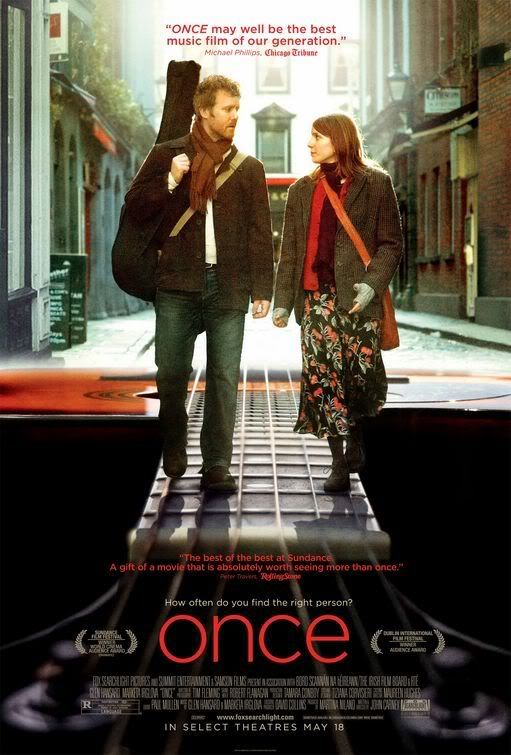
I saw this movie last week entitled: Once. Which, despite being horibly annoying when asking people if "they had seen the movie Once" they would almost always reply "Yeah, it was so good i saw it twice. " Not funny. Unfortunately not that many people saw this documentary exploring the sidewalk singer/poet. This heart-warming tale tells the story of a man - Glen Hansard - and how he is trying to break into the music world. Starting from a sidewalk singer, and ending with selling records in London. However, he does not do this alone, he finds this muse in the form of a Czech woman named Marketa Irglova. She helps him take his mind of his ex-girlfriend, and then writes songs for her. I probably did an incredibly subpar job of doing the plot description. I hope i do a better review.
All in all, this was a pretty great movie, i really loved the incorporation of music to really express the feelings of the main character - Glen, at first it is disturbing, brash, unrefined. yet by the end it is beautifully constructed and appreciated by all around him. The seamless incorporation of the music into the movie really made the movie personal, which made it all the more moving.
The style it was shot in could best be described as mainly medium shots. It is almost entirely done as natural shots, very little cinematographic aspects incorporated. Which, again, made the movie the more personal. It allowed the watcher to be viewing it like it is just a passer-by - it is best described as being in the Third person narrative. Excelently directed in its lack of direction. if that makes any sense.
Either Way! it was an incredibly touching movie and i reccomend it to all. Especially if your looking for a romantic date movie. I really liked this song from it entitled "Falling slowly," check it out!
Sunday, September 23, 2007
Excited for the new week!
its a new week of art of film and that means only one thing- a new movie! I'm psyched to see what Daz has in store. A comedy? a Drama? A Dramedy? who knows? only time will tell!
Wednesday, September 19, 2007
Witness
We are two days into Witness, and i have to say it's pretty OK so far. I don't really dig the story that much, but directorilly its pretty good. That one scene where the kid was pointing at the picture of McFee - that was really cool. It was like the whole room stood still except for Harisson ford and the kid.
So far I'm really liking this class, it's nice to know that at least one period in a day, you get to watch a movie
So far I'm really liking this class, it's nice to know that at least one period in a day, you get to watch a movie
Subscribe to:
Posts (Atom)